
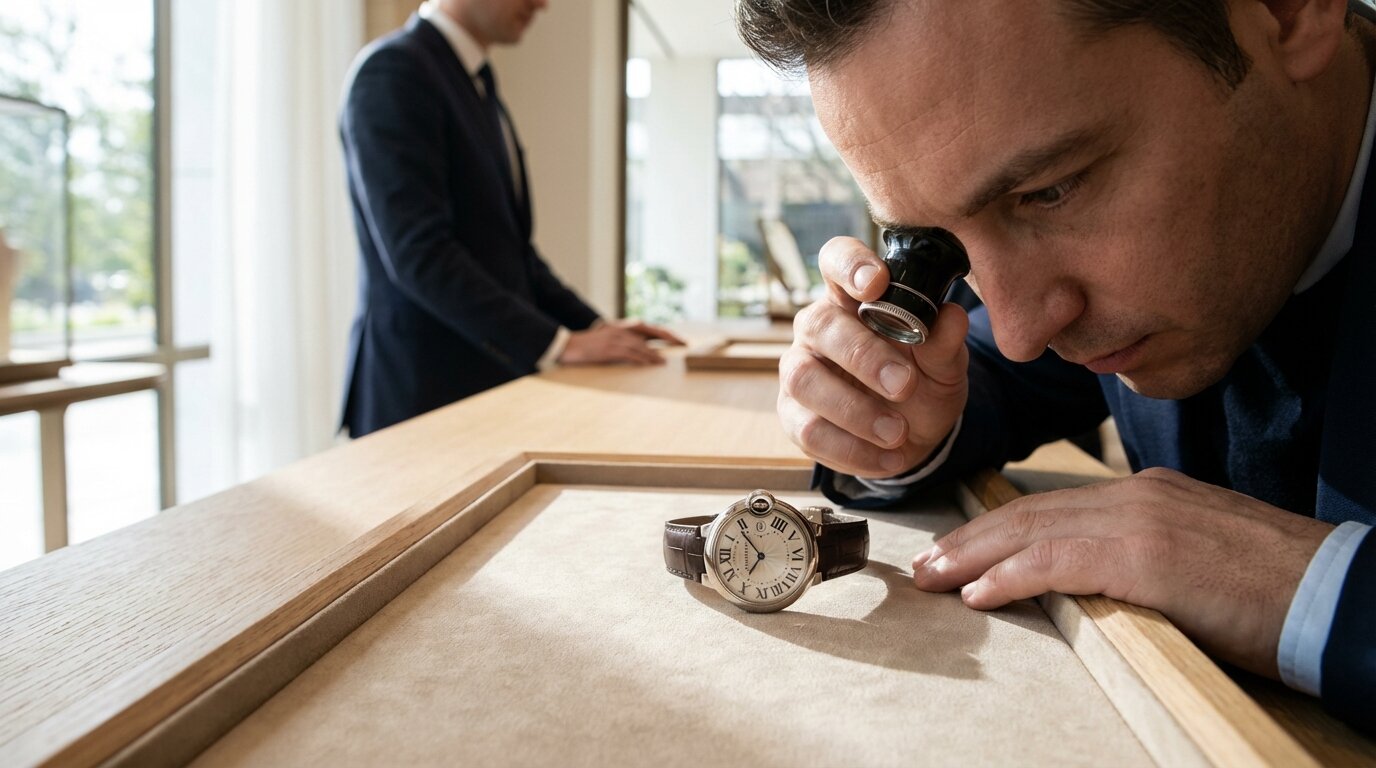
The 2026 Cartier problem you can spot from across the counter
A Cartier Watch is one of the easiest luxury pieces to wear daily. It’s also one of the most copied, which makes Cartier watch authentication a 2026 skill.
I see the same story repeat in London every week. A buyer falls for a tidy listing with soft lighting. The watch arrives. The details feel slightly off.
Good fakes have improved in 2026. They still fail in predictable places. This guide shows you where to look, what to measure, what to ask for, plus when to stop guessing.
Provenance first, before you even touch the Cartier Watch
Start with paperwork. A genuine set can be messy. A fake set can be too perfect.
Ask for a clear photo of the warranty card, booklets, outer packaging labels, plus any service invoice. If the seller won’t share these, you’re not buying a watch. You’re buying a story.
For Cartier watch authentication, the strongest evidence is a service trail. A Cartier service invoice with a matching serial is harder to fake than a box. It also ties the piece to a known client history.
- Seller name matches the invoice name, or there’s a believable link
- Serial appears consistently across documents
- Service dates are specific, with parts listed
- Return address looks real, not generic
One more thing. A Cartier Watch sold as “unworn” in March 2026 should still show handling marks on polished surfaces if it’s been photographed often.
Cartier Watch features fakes still struggle to copy
There are Cartier watch features that counterfeiters mimic well. There are also small brand behaviors that trip them up. You need to look like a repairer, not a shopper.
Start with the crown. Many models use a cabochon. On the real thing the stone seats cleanly with crisp edges to the metal. On fakes it can look glued, cloudy, too tall, or oddly colored.
Next, the dial signatures. Cartier often hides a tiny signature in the dial printing. It’s not always in the same place across models. It should still look deliberate under magnification. A blurred micro signature is common on copies.
Bracelet feel matters. A Cartier Watch bracelet should articulate smoothly with controlled play. Cheap fakes rattle. Better fakes feel tight at first, then bind at odd angles.
Weight, balance, and the “too light” tell
If you handle watches daily, weight gives the game away fast. In early 2026, my own shop notes show that around 20% of suspect pieces feel wrong before you even see the movement.
Don’t rely on weight alone. Some fakes add metal to cheat the scale. Focus on balance. A head heavy feel on bracelet models is a red flag.
Dial, hands, and printing: where a genuine Cartier watch earns its money
Dial printing is where a genuine Cartier watch looks calm. Lines are clean. Spacing is consistent. The ink sits flat.
Pull up a high resolution image from a reputable dealer listing. Compare font weight, minute track spacing, plus the center alignment of the numerals. Fakes often get the “feel” right. They still misplace details by a hair.
Hands are another giveaway. Blued steel hands should show a controlled color shift under light. Many fakes use painted hands that look uniformly blue. In 2026 I still see this on mid-tier copies.
Check the crystal edge. On a real Cartier Watch, reflections tend to look tidy. On a fake you can see distortion at angles. That’s often a cheaper crystal, not just dirt.
Case finishing that looks too eager
Over polishing is not only a vintage issue. Some counterfeit cases are finished to look “extra shiny”. The edges lose definition. Screws can look soft.
Cartier case finishing should show intention. Brushed areas are consistent. Polished areas don’t spill into brushed sections.
The movement reality check for a Cartier Watch
If the seller refuses a movement photo, walk away. A Cartier Watch is a luxury item. Basic transparency isn’t a big ask.
Quartz models are commonly faked because buyers assume “battery is simple”. A real quartz Cartier still has precise fit inside the case. You shouldn’t see rough plastic spacers. You shouldn’t see smeared gasket grease.
Automatic models bring clearer tells. Screws should sit clean. Rotor engraving should look sharp. Random decorative stripes can be a trap. Some fakes over decorate to distract you.
If you can, ask for a timing printout from a watchmaker. In 2026, a basic check in Hatton Garden is often £40 to £80. That’s cheap insurance on a four-figure purchase.
- Ask for amplitude and beat error figures from a recent test
- Confirm quick set date behavior if the model has a date
- Listen for rotor scrape in a quiet room
- Check crown feel through winding and setting
Engravings, serials, and paperwork matching on your Cartier Watch
Serial numbers are necessary. They’re not sufficient. In 2026, serial duplication across listings is common. I’ve seen the same number appear on three separate marketplace adverts in one month.
Engraving depth matters. A genuine caseback engraving looks confident. It has clean edges. Laser etched fakes can look grey, shallow, plus slightly fuzzy.
Check that the serial format suits the model family. Also check spacing. On a Cartier Watch, text alignment rarely looks rushed.
Then match everything. The serial on the watch should match the serial on the warranty card. If there’s a service receipt, it should match too. If one digit is “hard to read”, treat it as a no.
A quick word on “exhibition backs” and odd custom work
If a seller claims a rare caseback variant, ask for a Cartier service document that confirms it. Without that, assume aftermarket work. Aftermarket work can be fine. It can also hide a fake.
Buying Cartier Watch in 2026: where fakes circulate, plus what prices look like
Buying Cartier watch well is about venue choice. Bond Street boutiques aren’t where fakes enter the market. Private sales, social platforms, plus poorly moderated marketplaces are the usual pipelines.
Be skeptical of “quick sale” language. Be skeptical of pressure. In March 2026, the most convincing frauds are confident, polite, plus fast.
Price is the simplest filter. If a Cartier Watch is listed at 30% under the typical traded level, there’s usually a reason. Sometimes the reason is condition. Often the reason is authenticity.
| Model line (typical UK market in 2026) | Shop ticket range (pre owned) | Higher risk areas | My first checks |
|---|---|---|---|
| Tank Must | £2,200 to £3,600 | Dial printing, quartz internals | Dial fonts, crown cabochon seat |
| Santos de Cartier | £4,800 to £8,500 | Bracelet screws, case finishing | Bracelet feel, bezel edges |
| Ballon Bleu | £3,900 to £7,900 | Crown guard shape, handset color | Crown profile, hand finishing |
| Panthère | £5,200 to £14,000 | Bracelet build, clasp stamping | Link articulation, clasp engravings |
Those ranges are what I see on dealer tickets in 2026 across London, Manchester, plus reputable online retailers. Private listings can be lower. That’s also where risk rises sharply.
This is where Cartier watch value gets real. A cheap fake is worthless. A good fake can still cost you £2,000 plus stress. A real watch with poor condition can be a better buy than a fake with a clean story.
Use a simple rule. If you can’t verify it, you can’t value it.
Cartier Watch authentication routes that actually settle the question
At some point, you stop squinting at photos. You move to proper Cartier watch authentication. That means an independent watchmaker you trust, or Cartier itself.
In the UK, many buyers start with a respected workshop for an intake inspection. Expect £60 to £150 depending on complexity. If the case needs opening, you want someone insured. You also want someone used to luxury case construction.
The cleanest route is a Cartier service centre assessment. That can cost more, plus it takes time. It also creates paperwork that supports resale. That paperwork protects Cartier watch value far better than forum opinions.
- Independent inspection for a quick yes or no
- Pressure test if the model is meant to be water resistant
- Serial documentation with photos
- Full brand service when you plan to keep it
If you’re buying Cartier watch as a gift, insist on authentication before you wrap it. Surprises are lovely. Returns are not.
If you suspect your Cartier Watch is not genuine
Don’t confront the seller with a rant. Keep it clinical. Gather evidence, then act quickly.
Photograph the dial, caseback, clasp, crown, plus any paperwork. Take clear shots in daylight. Add macro photos if your phone supports it. That set of images helps a watchmaker confirm if you have a genuine Cartier watch.
If it was bought online, use the platform dispute process first. Keep your language simple. State that the Cartier Watch appears counterfeit and you want a refund. Mention that you’ll provide a professional assessment.
For your next purchase, set standards before you fall in love. Buy from a dealer with a premises. Buy from a seller who accepts inspection. Buy from someone who doesn’t flinch when you mention authentication.